Growth Advisory · delivering the Smart Performance Engine and Above-Market Growth practices

Growth a small team can actually carry.

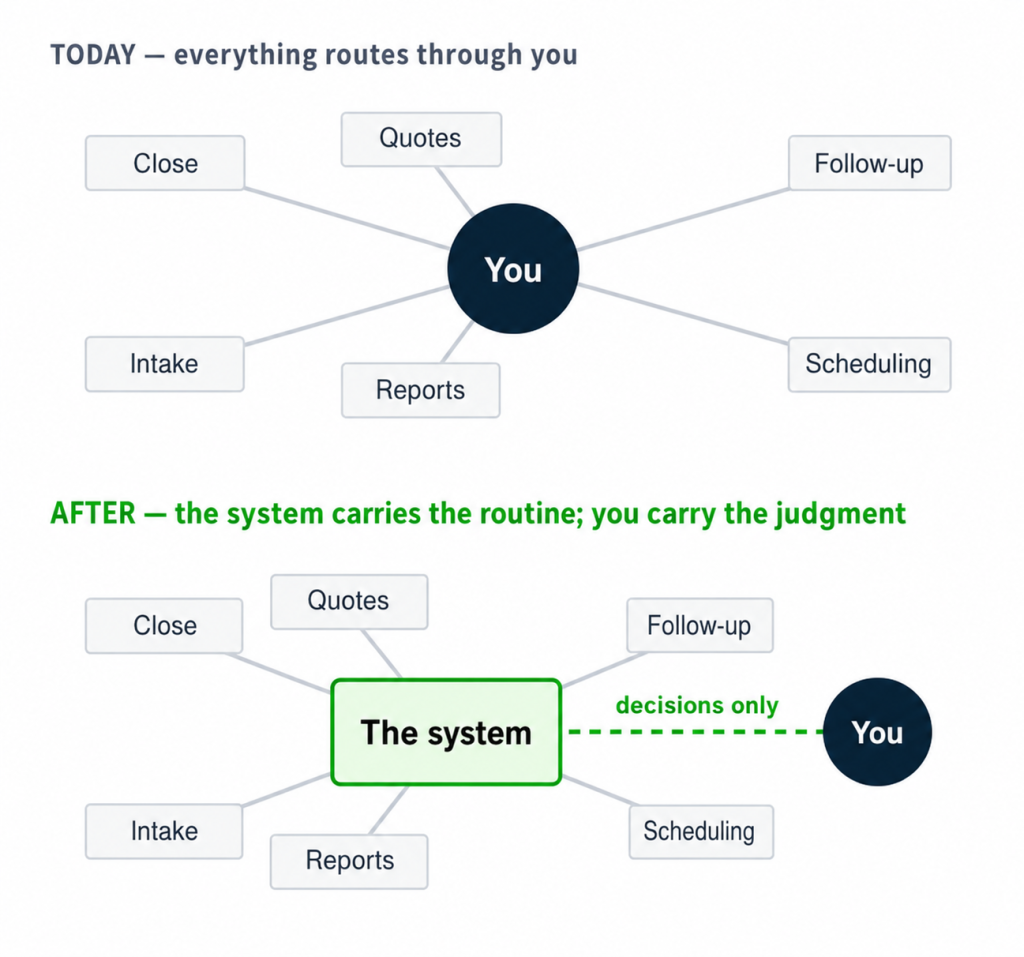
Plain terms: we rebuild how the work gets done so the company runs without you in every room, then we build the growth path — new channels, new markets, a second revenue line — that a small team can execute and a capital source can underwrite.

The process, in three steps.

Step one

Find the dependency

We map the five tasks that break when one person is out. Those single points of failure are the automation shortlist — they cut risk and raise valuation at the same time. Start with the work, not the software.

Step two

Build the engine

Clean the process first. Automate the part that is now stable. Put the health-of-business number on a dashboard that updates without you touching it. Automation layered on a broken process amplifies the mess — sequence is the discipline.

Step three

Engineer the growth

One adjacent market you could enter in two quarters, scored on demand, access, and margin before you commit a dollar. A second revenue line that does not depend on the first. Concentration is a discount at the negotiating table; diversification is a premium.

What you walk away with.

Dependency map

What stops when one person is out

Written procedures

The recipe for each critical task, out of one person’s head [SOP — Standard Operating Procedure: the step-by-step recipe for a task.]

Working automation

Repetitive work moved to systems your team can run

Owner's dashboard

The numbers that matter, updating themselves

Market-entry scorecard

The next channel, tested with data, not anecdotes

Operating cadence

The rhythm that keeps it running after we leave

Agribusiness, Food Systems & Regional Production

One person ran the close. Then she was out.

The problem pattern

Month-end close, reporting, and intake all lived in one employee’s head.

The MAG move

Wrote it down, automated the stable parts, put the number on a self-updating dashboard.

What changed

The close runs whether or not any single person shows up. That is a diligence asset.
Questions operators ask.

Do we need new software first?

Almost never first. Do not buy technology because the market says you should — buy it because you can name the work it will improve. We frequently remove systems before we add one.

It is built for exactly that. A small team can carry serious capability — but only when the work, tools, decisions, and skills line up. The question is not who to hire. It is what your current team should no longer have to do manually.

It replaces the work your people should not be doing — moving information between systems, re-entering data, chasing status. Judgment stays with people. The repetitive work moves to systems. Your best people get their day back.

The Discovery Session is free and fifteen minutes. Scope and fees are set after the dependency map, when the work has a name. We do not sell a platform, a license, or a retainer before that.